

2023 Banff Forum Report
Shannon Litzenberger | October 19-21, 2023
Fairmont Banff Springs Hotel, Banff, AB
In pursuit of strengthening the presence of artists in spaces of public policy discourse, I was delighted to join an invited group of policy thinkers, entrepreneurs, business and social sector leaders, academics, politicians, Indigenous leaders and artists gathered for the 22nd annual Banff Forum from October 19-21, 2023. The Banff Forum is a space for candid conversations across the public, private, and social benefit sectors about critical issues facing Canadians. It is a unique meeting point for thought leaders and changemakers wanting to expand their understanding of our shared society and imagine, together, what Canada’s future might look like.
Part of what makes the forum so attractive is the extraordinary community of Indigenous, Canadian and international leaders who attend. Participation is by invitation, mediated through a rigorous application process designed to balance perspectives, political orientations, interests, and lived experiences among the delegates. The event is a thoughtfully-programmed marathon of networking, speeches, dinners, and panels. Speakers offer their best thinking, proposing frameworks, strategies, and even potential solutions while the room challenges back with provocative questions and opinions. The forum has a formidable reputation as a valuable space of exchange about the future of Canada. Topics like the state of the federation, the economy, climate change, immigration, international relations, innovation, and technology typically frame the dialogue.
A unique feature of the forum is its multi-partisan nature, where influential people who hold a variety of political and ideological perspectives are present and interacting. We are all encouraged to share opinions, ask hard questions, and provoke generative debate. To avoid the performative politics that often unfolds in front of public audiences, the event operates with the Chatham House rule. We speak our minds and share our knowledge and our learnings, including lessons gleaned from our failures. A tone of mutual respect is strictly enforced even when passionate, contradictory opinions are being expressed. We are invited to share what has transpired, without attribution.
I joined the forum for the first time in 2021 as one of two inaugural Arne Bengt Johansson Fellows, alongside musician, creative accessibility researcher and now colleague with the Public Imagination Network, Leslie Ting. The fellowship was created on the 20th anniversary of the forum, with the explicit intention of inviting artists to participate in the debate.
Then, as a first-time attendee, my impressions were threefold. First, I noticed the scarcity of representatives from the arts and culture sectors and wondered why we weren’t more present in this critical discourse about the future of Canada. The creation of the artist fellowship was a clear action on the part of the forum to signal its desire to bring artists’ thinking into the fold and also an acknowledgement that artists were not typical participants in the past.
Second, I noticed the buzzing energy of the affable personalities that were circulating the space. They were an impressive group of mid-career leaders, including many passionate changemakers with big aspirations for mobilizing their ideas in the world. These leaders were well spoken, congenial, inclusive, and able to persuasively articulate their perspectives and ideas across industry sectors. When I spoke about my work as an artist, finding a common language was essential and hard work. I became hyper aware of the ways I needed to speak differently about the value and impact of my work in this space, resisting arts industry language and codes of interaction familiar in the arts world.
Lastly, I noticed that the current culture of policy discourse is driven significantly by a hyper intellectual space that leans heavily into knowledge as facts and skills, defended by logic narratives, informed by a mix of data, academic research, and perceived public sentiment. It felt challenging to shift the conversation away from conceptual debate focused on economic progress and growth as the uncontested terrain of building national prosperity.
Fast forward to 2023, two years after that initiating experience, and I am back at the Banff Springs Hotel for the 22nd annual Banff Forum. This year’s event was titled: Canada Rising to the Challenge: Bold thinking for a sustainable and prosperous future.
Panels and speakers addressed the state of the federation, cyber security, the housing crisis, economic development, leadership challenges, conspiracy culture, energy transition, AI and technology, immigration, and, yes, the arts.
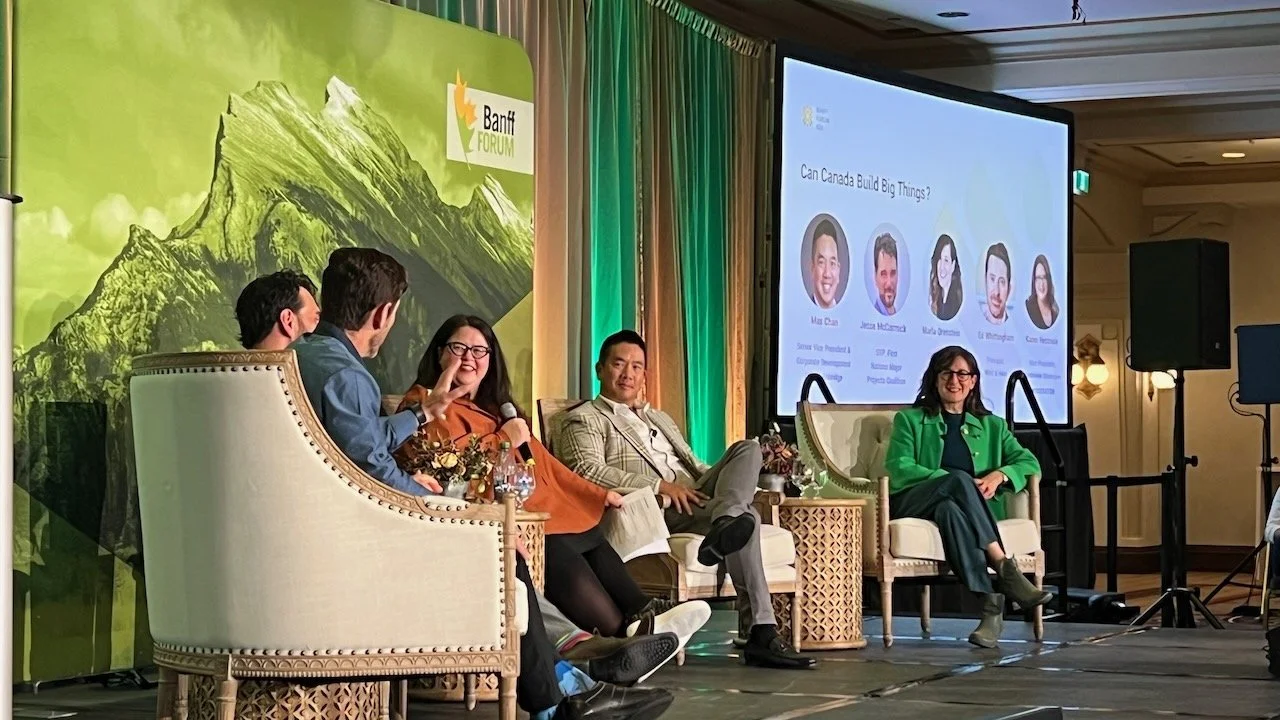
I had the great pleasure of leading a dedicated conversation on art, society and change at the forum joined by artists Sarah Garton Stanley (SGS), Raphael Freynet, and Tina Edan (the 2023 Arne Bengt Johansson Fellow). It took the form of a fireside chat – a more intimate space where delegates could be in a fluid exchange. Being the choreographer that I am, I asked for the space to be reconfigured as though we were sitting around the fire, rather than in front of it. This way, we could transform the typical two directional exchange from panel to audience into a multi-directional discourse.
Learning from my experience from two years ago, I decided to take up the question: What do artists have to contribute to public policy making processes? I contextualized the conversation by speaking about artistic processes as a knowledge system. I pointed to the work of psychiatrist, neuroscience researcher, and philosopher Iain McGilchrist whose work was highlighted in a recent CBC Ideas podcast The Divided Brain. McGilchrist studies the two hemispheres of the brain and their differences. He notes in particular how the left brain sorts and organizes and is concerned with order, control, categorization, manipulation and bureaucracy; while the right, more central to intelligence, understands our interconnected reality, sees movement and metaphor, discerns patterns and context, and is capable of reading humor, body language, and implied meaning. He asserts that over the past 100 years, modern society, including how it organizes and governs itself, has more and more begun to mirror the world of the left hemisphere, resulting in a distortion of our experience of reality. He argues that a rebalancing is critical and that, if anything, the right brain is dominant in humans and the left its agent.
If the arts, with their processes of creation and aesthetic strategies for meaning-making, are one of the few remaining facets of society that intentionally cultivates right brain thinking, then we would be wise to engage these practices in the collective decisions that matter most in our shared lives.
My artist colleagues offered invaluable perspectives on the role of artists as storytellers, as disruptors of the status quo, as meaning-makers, and as leaders of collective processes in the face of complex issues. They shared stories about how, through their own artistic practices, they have personally contributed to shaping meaningful community connection, including projects that helped people have challenging conversations about difference, strategies that helped bring about critical thinking using creative tools, and poetic interventions that supported shared sense-making amongst a diversity of perspectives.
When I turned the conversation toward the room and asked delegates about how they imagine what artists could bring to public policy making processes, the response was heartening. The themes that arose among them included the role of art in diplomatic relations, in sense-making using poetry and metaphor, in humanizing design processes related to public space and housing, in bringing dimensions of emotion into scientific inquiry, in communicating complex ideas including emotional realities as well as sentiments of care and justice in times of conflict, and the power of artistic ways of knowing to bring wisdom to the algorithmic thinking that drives decision making in government and business. They expressed the ways that art and aesthetic strategies make space for whole human engagement and connection. We agreed wholeheartedly that in this moment of major systems collapse, the methods and practices of artists are essential. Finding language to bridge the arts, business and policy worlds is key to engaging across perceived divides.
The session concluded with a call to action. Invite artists into your board rooms, your think tanks, your research hubs, your strategy sessions! There are many examples to point to elsewhere: Centre for Performance and Civic Practice (US), Reshape Network (EU), and CAIR Lab (US); and at least one right here in Canada: City of Ottawa’s Artist in Residence in Government.
For those of us working in the arts and culture sector, we must equally commit to showing up in spaces of policy discourse that extend beyond our industry-related interests. When the perspectives of artists are relegated to spaces of grassroots activism, and arts and culture doesn’t register in conversations among leaders about the future of Canada, we should be concerned. We must engage more actively in the issues impacting our communities, cities, regions, and our country. This is, at its core, a commitment to participating in the co-creation of our democracy, charged with the gifts of art as a way of knowing the world. This is how we will shift the narrative away from arts and culture as an economic lever toward arts and culture as a collaborative worldmaking process integral to a functioning, pluralistic democracy.
On the dance floor at the closing party, I heard that for some, the arts session was a favourite - a departure from the usual offerings and a welcome novelty that opened thinking about policy processes in a new way. In her departing speech, Banff Forum’s Executive Director Roxanne Duncan noted both the diversification of the delegation and the inclusion of artists as the accomplishments she was most proud of during her four-year tenure. She was instrumental in making this possible.
In a time of major systems collapse and amid a call for transformational change, we need imagination now more than ever, for the benefit of all Canadians. Artists are versed in processes of creation and, as artist/author Rick Rubin reminds us in his popular new book, The Creative Act “the act of creation is an attempt to enter a mysterious realm. A longing to transcend. Art is our portal to the unseen world.”
We need artists to engage their worldmaking capacities in service of a more inclusive, just, caring, yet-to-be-seen world. These aesthetic strategies and processes of fully embodied, integrative thinking are powerful. They can and will transcend the disintegrating organizing logics of our current world, creating new meaning and new possibilities for a better future.