


A Review of Kingston’s
Official Music Strategy
Evalyn Parry | ORIGINALLY PUBLISHED IN
Issue 18 of the Skeleton Park Press
Spring 2025, pg 20-21
Neighbourhood-focused, pulp-based journalism, free and serving McBurney Park and Surrounding Area.
In the City’s efforts to raise the economic potential of Kingston’s legendary music scene, housing and affordability loom large.
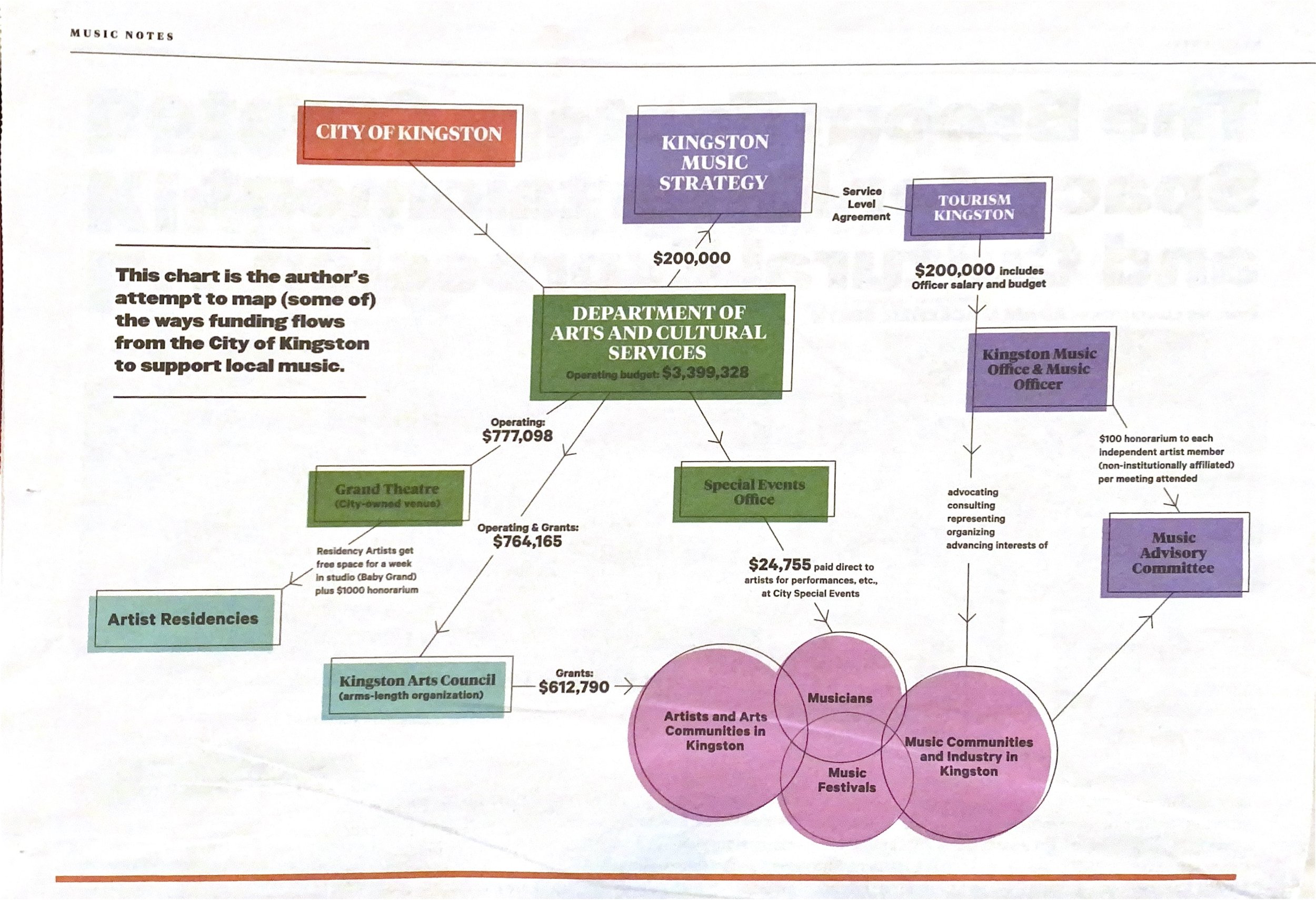
This chart is the author’s attempt to map (some of) the ways funding flows from the City of Kingston to support local music (with thanks to Vincent Perez for art direction/graphic support)
“Cities [across the country] have been embracing Music Strategies since we hit the affordability crisis.”
– CBC Radio, Victoria, Feb 2, 2025
The City of Kingston’s first official Kingston Music Strategy was adopted by City Council in December, 2023. My initial research into the development and implementation of the new Strategy quickly revealed that there was a lot to unpack. As a musician and theatre artist who has recently relocated from Toronto to the Kingston area, I was interested to discover that, while there’s a lot about the Strategy that is specific to Kingston, many of the issues it aims to address are part of a much larger national, and even global, picture.
It is news to no one that cities across the country – including Kingston – are in the midst of a housing and general affordability crisis. And across the country, the music industry finds itself between the proverbial rock and a hard place: in the era of Spotify, where most musicians can no longer make money off recordings, musicians are left trying to find other sources of revenue; playing live being one of them. But to play live, musicians need performance venues to play in, and many venues are also in a state of crisis: caught in the same web of inflationary effects of the real estate and rental markets.
The Music Strategy was developed by the City in collaboration with international consultancy firm Nordicity, who have created Music Strategies for numerous municipalities across Canada, Australia and the UK. These strategies all have a strong common theme: they make the case for music as a driver of the economy and tourism for a city. Kingston’s Strategy “builds on the rich activity already taking place within the city’s borders…celebrates Kingston’s past successes, addresses where there is room for improvement and cohesion, and ultimately paves a coordinated path forward towards a shared vision: for Kingston to be recognized as a hub and incubator for musician development, music careers and a strong music scene, where music is ubiquitous and can be seen and heard by all.”
The forty-two page Strategy document is based on lengthy consultation with local music community stakeholders, including musicians, promoters, venue owners and more. It outlines a series of recommendations, supporting actions and timelines for the City’s investment in the sector to “enable economic development, support economic recovery due to the impact of the COVID-19 pandemic, maintain activity, and facilitate growth”. A foundational recommendation is the creation of a Music Officer position “to lead the implementation of the Kingston Music Strategy, in collaboration with the City's Arts & Culture Services Department, while acting as a contact point between the City and the music industry.” The Strategy recommends establishing an advisory group of stakeholders from local music communities, to consult with and inform the Officer’s planning. And, in order to expand the impact of the Music Officer’s role, the Strategy recommends “establishing a standalone Kingston Music Office,” with a mandate “to assist in the execution of music strategies (such as this one) and to nurture the growth of the local music industry and those who work in it.”
When the City approved the Strategy in Dec 2023, they allocated a $200,000 budget, to cover the first year of Music Officer salary and start-up for the Office and its activities. The longer term recommendation of the Strategy is to build toward a budget of around $450,000. Kingston’s new Music Office is situated within Tourism Kingston, rather than the City’s Department of Arts and Culture, something that has caught the attention of several musicians around town.
To better understand this positioning, I sat down with Danika Lochhead, the Director of the Department of Arts and Culture. She explained to me that, while many municipalities structure their offices in such a way that directly links arts and culture with economic development, Kingston separates them into three distinct entities: the City’s Department of Arts and Culture, and two agencies: Tourism Kingston, and Kingston Economic Development. (The City is governed by Council and funded by tax dollars, whereas Tourism and Economic Development each have their own board of directors and are funded through a variety of public and private sources). Both agencies receive a significant portion of their funding from the City, in the form of Service Level Agreements (SLA’s) through which these agencies deliver services, projects, and priorities on behalf of the City - such as in this case, The Music Strategy. So while Tourism houses the Music Office and Officer role, the City retains the ability to modify the agreements and structures of reporting and accountability with these partner agencies.
The Music Office/r
Kingston’s new Music Officer, Moira Demorest, is well known in Kingston as a musician, educator, and a founder of Kingston Punk Productions (or ‘KPP’, a prolific indie concert production company). Prior to running the Music Office, Demores spent a year as the “Music Commissioner” at the Film Office (another office that sits at Tourism, though not funded by the City). She describes her new role as focused on “creating the conditions for a thriving local music industry”: similar to the initial, ‘Music Commissioner’ position, the difference being that now she has “the official Music Strategy from the City to support it”. She laughs when she tells me her “Office” is really a one-person operation, but it was titled with the larger vision in mind. She notes that Tourism saw the Music Office as an opportunity, where no other city Department or agency seemed to have the resources, or jumped at the chance to house the office.
Her job, she says, is to “advocate for music not just as entertainment, but as an economic and cultural driver. That means policy - where there is currently none. This is an industry that relies so heavily on other policies (noise bylaws come immediately to mind as an example) but until now, music hasn’t had a voice at the policy table.” Policy, she says, “needs to invest not only in talent but also in venues. The music sector was established on a model of bar sales - and that is shifting”. It turns out that not only are bars dealing with inflation and rising rents, but they face an additional challenge: “plummeting alcohol sales, which have been steadily declining over the last decade”.
This was a factor I hadn’t considered. The symbiotic relationship between bands, bars and alcohol sales has functioned, until recently, like a kind of unofficial, invisible support structure undergirding a precarious industry. But if live music doesn’t increase the bottom line of bar sales, there is less incentive for bars to book bands – especially new bands – or to pay them well. Many venues have adopted the insidious “pay to play” model, whereby artists pay a fee to perform and promote their art, rather than the other way around.
When I ask Demores what she has learned in her first year on the job, she immediately responds,“learning to work within bureaucracy.” Her many years working in the local music scene mean she has a strong network of connections and partnerships, and her role as Music Commissioner gave her a primer in policy-making, but she says “in this role, I’ve had to learn patience. I can’t leap straight into DIY problem-solving the way I used to. I see the issues, but instead of being reactive, I have to learn how to step back, look at the larger systems, and ask myself: what policy or resource could be put in place here to improve the conditions?”
Both Demores and Lochhead are quick to acknowledge that we are still in early days of the Strategies implementation, and that this kind of work - both the relationship-building and policy change - take a lot of time. When I ask what the biggest challenges are, Demores says, “the music industry is the challenge: the systemic problems in the industry. Such a small portion of resources trickles down to musicians. I’m trying to figure out how to lead incremental changes to shift that percentage. I wish I could say we have fair wages for everyone. We don’t.”
In May 2025, Lochhead will report back to City Council on what has been achieved in the first year of the Strategy’s implementation, anticipating the City will renew the SLA with Tourism at the same($200,000) amount for a second year. Both Lochhead and Demores noted that a Fair Wage campaign is a priority for the second year of the Strategy; Lochhead also says in the coming year, the call for the Music Advisory Committee will be renewed; it needs to be revised to ensure representation, membership and terms limits.
Conclusion
Music Strategies much like Kingston’s are now in place in cities throughout Canada and around the world: Toronto, Hamilton, Ottawa, Vancouver, Victoria, Mississauga, London (Ontario); abroad, Melbourne, Glasgow, Austin…the list goes on. When I ask Demores to identify the biggest success so far of Kingston’s Strategy, she says,”that this Office is here now.” She acknowledges “there have been bumps. It’s a new organization. Putting arts into bureaucracy is like fitting a square peg into a round hole.”
But if budgets are a storytelling document, then Kingston is beginning to tell the important story about the role music plays in the health and vitality of the city. By implementing the Music Strategy, Kingston is signalling that they value music in Kingston, not only for its cultural and social benefits, but also for its role in the urban identity of Kingston itself.
However, I also see a strong critique to be made about what seems to be a foundational premise of Music Strategies: that a thriving music industry promises to be a revenue generator, attracting more tourism, and helping to build a more desirable and liveable city. This argument aligns with the neoliberal economic philosophy that promises the market will provide solutions to socio-economic problems. I would argue the systems failure that we are currently living in is the result of the last 30 years of this neoliberal economic thinking, coupled with decreasing public investment. A Music Strategy, while it may bolster the sector, will not solve the housing crisis: radically new housing policy is the thing that is needed. When we think of many of the country’s most renown musical acts - Kingston’s Tragically Hip, Arkells in Hamilton, Montréal’s Arcade Fire, Sloan in Halifax - a common theme is that they came up in a time and place where rent was cheap, and life was affordable enough that artists could afford to put time into their “emerging” careers without having to work another full time job or a million side hustles.
In light of the big, underlying problems of our moment – namely, affordability and housing – I wonder if Kingston’s Music Office could lead the way toward even more innovation. What about putting musicians on EVERY committee at the City? Put artists on a housing advisory, transportation advisory, waste management advisory, and more. Pay them an honorarium to sit on committees that allow musicians to influence not just music, but the many intersecting systems that impact our communities. By leveraging the uniquely creative approaches and practices of artists, Kingston could blaze a real trail: collaborating with artists to help find new solutions to the interconnected crises that no government in the country currently seems to be able to solve.